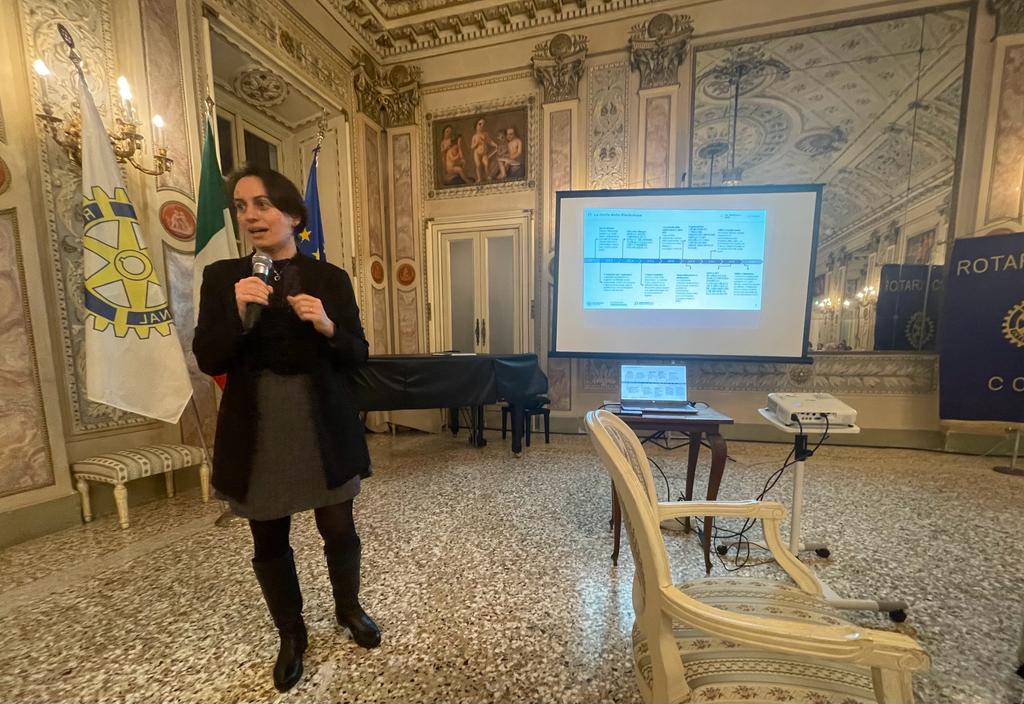

“Blockchain, Web3, and Cryptocurrencies: Adoption Status and Future Developments.” A rather bold choice by our President to propose as a presentation for the dinner meeting on February 2nd. Yet the speaker, Eng. Valeria Portale, had the ability to attempt to make us digest such a difficult subject, especially after a dinner based on cassoeula with polenta.
We are facing an epochal change that began in 2008 when an anonymous Satoshi Nakamoto published the Bitcoin protocol: a technology for transferring money from one person to another without intermediaries. The following year, the elusive cryptocurrency was worth 1 Bit (today 1 Bit is worth 20,000 Euros!). However, in those years, it remained a niche product and was even discouraged. The underlying technology is called “blockchain” and is a computer network of nodes that uniquely and securely manages a series of data and information, such as money transactions, without the need for central control. In 2014, banks began to study this technology for use in the banking world, but it was in 2015, following the publication of an article on the front page of The Economist, that an initial phase of investment began.
In 2018, a downturn in the cryptocurrency market occurred, but at the same time, several companies demonstrated an interest in this technology with the production of alternative finance. In 2020, the ECB also planned an alternative currency called the Digital Euro, with the aim of giving consumers the opportunity to benefit from a new, fast, and secure payment instrument guaranteed by a central bank, with virtual exchanges between multiple users as if it were real currency. Through cryptography, users are therefore guaranteed cybersecurity by having a key to open their digital wallet; furthermore, this technology “disintermediates” the actors in the middle: an algorithm manages and verifies the steps that were previously managed by the bank. To date, many companies invest in this technology (e.g., banks, Public Administration, Telecom, Automotive, Healthcare, Energy & Utility…). Even the Revenue Agency is interested in it but, curiously, still lacks technicians capable of interpreting the technology (!). Web3 is based on Blockchain technology. Therefore: in Web 1.0, Internet pages could only be used by the user in a passive way. With Web 2.0, the user can participate in the creation of content (what our Club’s Social Commission does, for example). Web3 changes the hierarchy of previous Webs, where managers were the keepers of sensitive data, by allowing the user to become the owner of their own content with the advantages of decentralization, security, and anonymity. Be careful, however: these are innovative technologies that are still only manageable by super-experts. Perhaps for all of us, for now, the suggestion could be to keep our non-virtual wallets safe in our banks…
LF