
The project
In 2007, on the occasion of World Sight Day, a very young writer, Elisa Raimondi, published a small book entitled “Even Princesses Wear Glasses”, in which she describes, through the language of fairy tales, her love-hate relationship with her “magic lenses.”
There are everyday actions that adults perform without even thinking, but which are much more difficult for children. One of these is simply putting on a pair of glasses. Elisa experienced this difficulty from an early age, but thanks to her mother’s patience and her own determination, she learned to accept and overcome it.
From this experience came the inspiration to write a story set in an imaginary kingdom, where a princess regains her lost smile with the help of the Iris Fairies and two enchanted crystals. A child can see them as a pair of glasses, while an adult can see them as magical eyes that help us look at the world without prejudice and discover all its colours.
Dr Roberto Magni, who assisted Elisa for many years in helping her face and overcome her vision problems, believed that this book could become the basis for a visual prevention project aimed at very young children. Thus, Project Elisa was born.
Today, thanks to modern technology, it is possible to diagnose amblyopia, more commonly known as lazy eye, at an early stage, as well as other significant vision disorders, allowing timely treatment. Every year, amblyopia affects approximately 3% of newborns and can lead to blindness in one eye if left untreated.
According to the World Health Organization, amblyopia is one of the leading causes of visual impairment in childhood and among young people under the age of twenty.
Because of the lack of prevention, 35% of children currently attending school wear glasses and often experience learning difficulties that may be related to vision problems.
Preventing amblyopia also has a positive socio-economic impact, as numerous studies have shown that the cost of preventive vision screening is far lower than the social costs associated with untreated visual disorders.
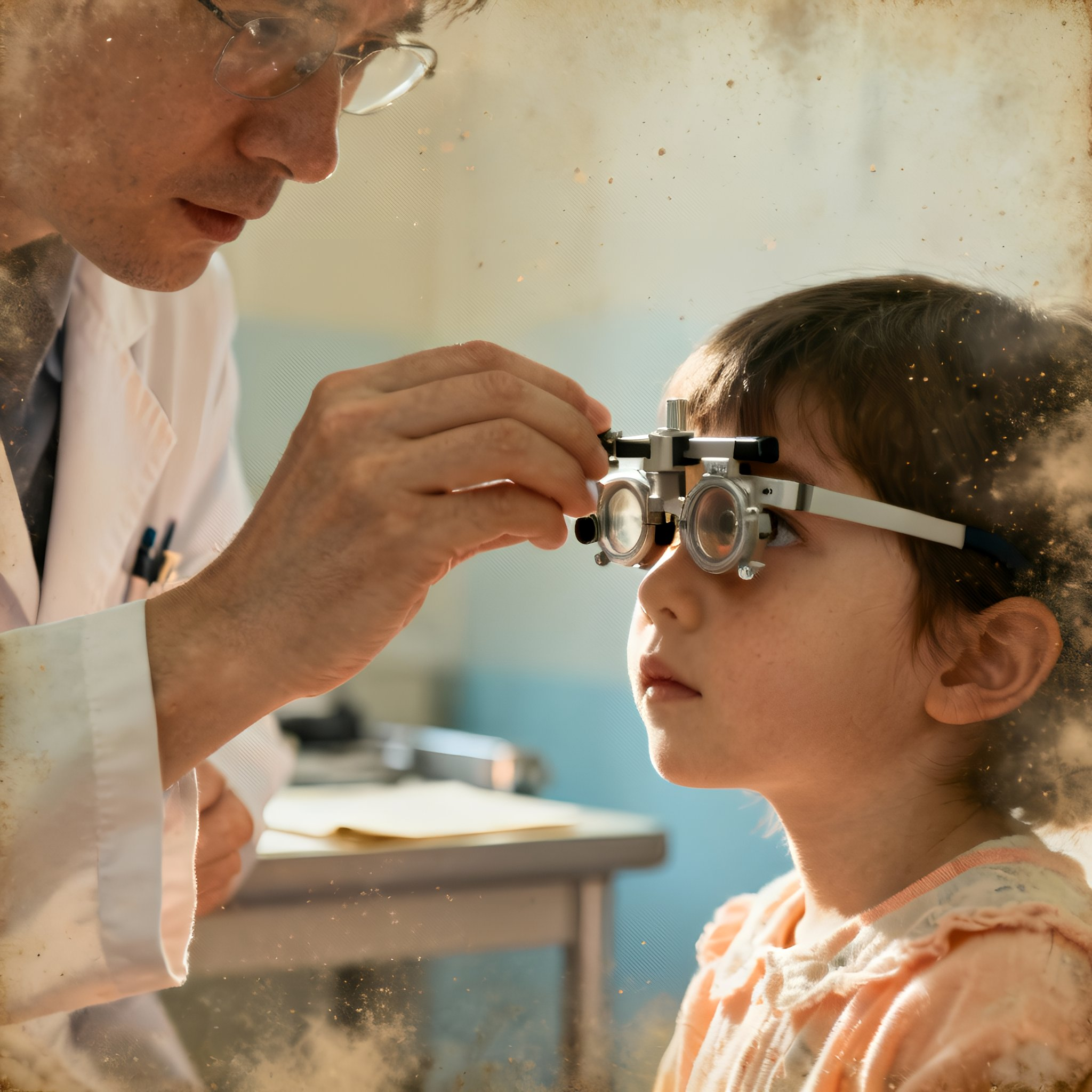
Project Elisa promotes free vision screening for young children in order to enable the early diagnosis of amblyopia.
Thanks to these examinations, it has been possible to identify significant vision problems at an early stage, allowing effective treatment through timely diagnosis.
It is during the very first years of life that visual function develops. For this reason, any factors that may interfere with this development should be identified and, where possible, removed.
Early diagnosis is especially important in cases of lazy eye, since the chances of recovering vision through appropriate treatment decrease in proportion to the child’s age.
Throughout the medical and scientific community, prevention is recognised as essential to ensuring good health and a better quality of life.
In Como, free vision screening for children between 6 months and 3 years of age was organised in collaboration with the Municipality of Como – Department of Education, represented by Deputy Mayor Silvia Magni.
The screenings took place on Friday, 31 March, from 9:00 a.m. to 6:00 p.m. at Palazzo Cernezzi, Sala Stemmi (Via Vittorio Emanuele II), and on Sunday, 9 April, during Lions Day, in Piazza Grimoldi, from 10:00 a.m. to 5:00 p.m.
The examination report, consisting of a binocular autorefractometry test, was provided to parents immediately after the screening.
RESULTS
– 320 letters were sent to families of children in Como aged between 16 and 22 months.
– 96 children participated (30%).
– 74 children (approximately 77% of those examined) showed no vision defects.
– 13 children (approximately 13%) were found to have non-alarming vision defects.
– 10 children (approximately 10%) presented vision problems requiring an urgent ophthalmological examination.
REPORT
Each parent received the screening results from an ophthalmologist or an orthoptist.
Even parents whose children showed no vision problems were informed about the purpose of the screening. In particular, it was explained that the screening could not assess the risk of strabismus, as this can only be evaluated after the administration of eye drops.
Parents were also given recommendations on the correct management of eye conditions during early childhood.
Each family received the child’s clinical documentation, including the results of the examination.
PARTICIPATING PROFESSIONALS
The following medical professionals took part in Project Elisa:
1 ophthalmologist
1 orthoptist from Verbania
1 orthoptist from Monza
1 optician
2 qualified technicians
using five diagnostic devices for the early detection of vision disorders.
The following representatives also participated in Project Elisa:
Rotary Club of Como: Sandro Ferrara
Rotary Club Como Baradello: Fulvia Bianchi Longo
Lions Clubs: Gino Ballestra and Roberto Simone
Lions Club Plinio il Giovane: Giuditta Barzetti
Italian Union of the Blind and Visually Impaired – Como Provincial Section: Claudio La Corte (President)
Mayor Mario Lucini, together with other local authorities, as well as members of the Lions and Rotary Clubs, visited Sala Stemmi, where the vision screening was taking place.